Free sample
Introduction: The Uncompromising Truth
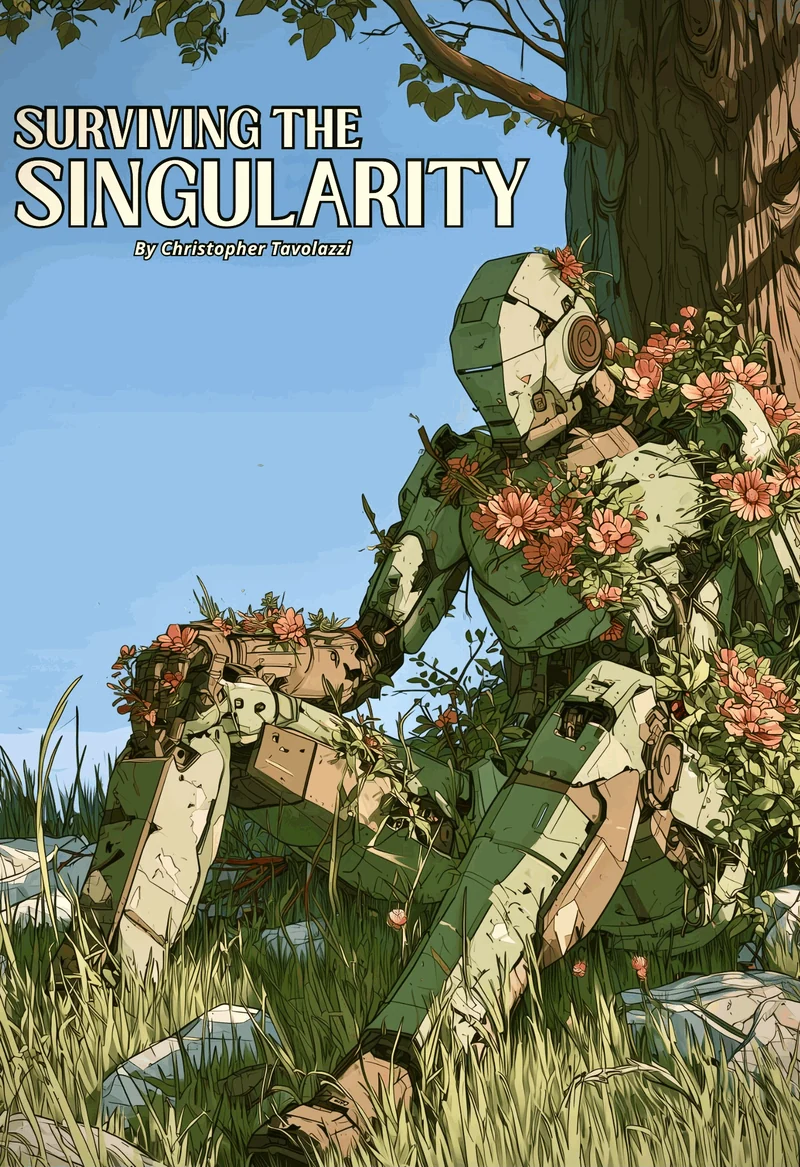
From Surviving the Singularity
Atlas during testing. The data does not care how you feel about it. (DARPA, Public domain, via Wikimedia Commons) "It is difficult to get a man to understand something, when his salary depends upon his not understanding it!"
Upton Sinclair, I, Candidate for Governor: And How I Got Licked (1935)
In this chapter:
My forecast is AGI by Thanksgiving 2027. Everything this book asks you to do stays worth doing if I'm wrong. We don't have to live like this. There's enough food for everyone; the rules that make survival cost money are choices, enforced, and choices can change. Food first: adequate food for everyone, regardless of income or employment, as the first commitment of a bigger one. The machine is new. The stampede isn't. Every chapter ends with a documented case from the Precedent Ledger. It's time. It's finally time.
For years, I've been talking about this, and for years, I've been labeled the local crackpot. I've watched people I love look me in the eye like I'd finally lost it, like I was spinning some paranoid fantasy. They might tell you they moved on because I'm an asshole, and maybe they're right. But I'm not wrong about the trajectory.
For years I wanted someone with credentials to say it first. Not because I was unsure of my own math, but because as long as the industry dismissed AGI as fringe, sci-fi nonsense, nobody would listen to a guy like me saying it out loud. What I'm talking about is a system that can understand its own architecture and help engineer the next version of itself. Not a smarter search box. A tool that can invent new tools.
Every revolution before this one changed what our hands and backs could do: the plow, the press, the engine, the airplane. This one is intellectual. We have automated thought itself, and it doesn't need a giant server farm anymore. Useful models run on consumer hardware in people's homes. Between November 2022 and October 2024, the price of querying a model that matched GPT-3.5 on MMLU, a language-model benchmark, fell more than 280-fold. That's a price comparison at one measured performance level, not proof that every task got equally cheap. Stanford HAI, 2025 AI Index Report, chapter 1
The loudest voices in the room are working from a headline and a Reddit thread they skimmed once. That's noise, and noise is cheap. I'm not asking you to trust me over them. I'm asking you to go around all of us. Stop listening to the guys in lab coats who have a vested interest in keeping you afraid, and stop listening to me while you're at it. Get your goddamn hands on it. Use it yourself. Then you'll know.
My call, for the record: AGI by Thanksgiving 2027. That's a forecast, not a law of physics, and Chapter 1 tells you exactly what would prove me wrong. Everything this book asks you to do stays worth doing if I am.
And I'm not worried about the machines. I'm worried about two very specific things: missing our window to get this right, and what bad actors and sociopaths will do with it.
Surviving the Singularity means keeping people fed, housed, and cared for as machines take on more of the work we're paid to do. It means having a say in who owns the tools and who gets their benefit. Start with food: a lost paycheck shouldn't decide whether your family eats. We can begin now, with farmers, cooks, neighbors, useful machines, and public institutions. My forecast may be wrong. A dependable dinner still matters. The work is making survival less precarious for everyone.
The second ox
Atlas, outside the demonstration room. AI-adapted cutout from DARPA , public domain . Here's the thing the panic keeps you from seeing. Staying alive takes work. A plow can make that work easier, but the plow doesn't pull itself.
Domestication let us hand some of the heavy work to an animal. Put an ox in front of the plow and human muscle no longer has to supply all the pulling power. You still have to train it, feed it, guide it, and care for it. You don't get to point it at a field and walk away. But you no longer have to do all the work with your own body. FAO, Draught animal power and implements
Call this the second ox. That's a way to see the machine under all the doom. Not a god arriving to end us. An animal we're learning to domesticate, one that happens to think. The promise is familiar: hand over more of the work of keeping yourself alive. The responsibility is familiar too: build the system, maintain it, and decide what work it should do.
An early way to hand over some of the heavy work. Training, guidance, and care still belonged to people. Which is why "it's all over" and "we're so back" are the same facts read by two different kinds of people. The tools don't decide which one comes true. People do. Ask someone to imagine a machine that can do most jobs and watch them leap straight to the apocalypse, skipping clean over the far likelier outcome, which is not the end of the world and not even the end of capitalism. It's easier to imagine the end of the world than the end of capitalism, the line goes, and you can watch the reflex fire in real time. But the markets will still be here. What can end is the part where you have to sell your day to be allowed to eat. That can become optional. Not abolished. Optional. And optional is the whole ballgame.
What if it all goes right?
Not flawlessly. Not without arguments, broken machines, bad decisions, or people who try to keep the best parts for themselves. What if we get capable of doing much more of the work that keeps us alive, and decide that being alive should get less frightening?
Imagine being fired on a Tuesday. There's still an awful conversation to have at home. There are plans to change and bills to sort out. But dinner is already taken care of. Your family can eat tonight, tomorrow, and while you figure out what comes next. Losing the job has changed your life. It hasn't revoked your permission to have one.
That's where I want to begin.
If these things are going to take all our jobs, why not make them grow our fucking food first?
Listen to the rest of the sentence
When someone says, "AI will take my job," listen to what follows. How will I pay the rent? How will I feed my kids? What happens if I get sick? Sometimes those questions get spoken. Sometimes you can hear them in the silence after the first one.
That fear deserves an answer. Telling a frightened worker to be excited about productivity is a failure to listen. So is telling them that people once feared the printing press. A comparison with a dead person doesn't pay a living person's electric bill.
But listen to what the fear reveals about the arrangement we live inside. We can get better at producing useful things while people get less able to obtain them. The food can still be growing. The houses can still be standing. The machines can be doing exactly what they were built to do. And a person can lose the income that gives them access to any of it.
There's the contradiction.
When I criticize capitalism in this book, that's what I mean: productive capacity and human security can move in opposite directions. If a machine helps grow the food and the person it displaced can't afford to eat, the failure isn't that we learned to grow food more efficiently. It's that we failed to carry the benefit through to the person.
The leap from "a machine can do my work" to "my family might go hungry" is an indictment of that failure. We've made employment carry responsibilities that matter more than any particular job. We can share those responsibilities differently.
A gain in our ability to produce should become a gain in our ability to live.
We don't have to live like this
Here's what I actually believe, as plainly as I can say it.
We don't have to live like this.
We could have a beautiful world where AI and robots provide for the physical survival needs of every single person. Robots grow our food and build our houses. AI helps cure our diseases, helps us learn and grow, helps us explore the universe, and helps us discover new ways of building new kinds of technology, better societies, and a better life for every individual person.
We don't have that, and it isn't because we can't make enough. The United Nations says it flatly: "today's global food production is enough to feed everyone on the planet." United Nations, Food In this country, by the government's own estimate, 30 to 40 percent of the food supply goes uneaten, and California's Department of Food and Agriculture says Californians throw away five to six million tons of food every year. CDFA, Food Recovery
So why should food be denied to hungry people because it doesn't sell?
Because almost everything in this world has been arranged around money, as if nothing else actually matters, and that arrangement is enforced. A credit report and a private risk score decide whether a landlord will rent to you. CFPB, Reports Highlight Problems with Tenant Background Checks Your attention and your personal data are harvested and sold, the business model Shoshana Zuboff named surveillance capitalism. The Age of Surveillance Capitalism
Between 2000 and 2018, landlords in the United States filed more than 3.6 million eviction cases in an average year. Gromis et al., Estimating eviction prevalence across the United States When a family loses one, California's own courts spell out what comes next: "The sheriff gives you a Notice to Vacate," five days to move, and "if you don't move out, the sheriff can lock you out of your home." California Courts, What happens if you lose your eviction case That's what it means when survival costs money. If you can't pay, a person with a badge and a gun is authorized to come and put you out.
Meanwhile the money piles up at the top. In 2017, Oxfam found that eight men owned as much wealth as the poorest half of the world. Oxfam, An Economy for the 99% By January 2026, billionaire wealth had grown 81 percent since 2020, to $18.3 trillion, and billionaires were 4,000 times more likely than ordinary people to hold political office, while one in four people on Earth didn't regularly have enough to eat. Oxfam, Resisting the Rule of the Rich (2026) The people at the top of that pile have every reason to keep the rules exactly as they are.
Food insecurity rose sharply in 2008. These household survey estimates show a historical pattern, not a causal test of job loss. Very low food security is included within food insecurity. USDA Economic Research Service, 2001 to 2024. That system of rules is enforced. It doesn't have to be.
If you want to make a billion dollars and buy things, fine. Go for it. But why should everyone else have to suffer at your expense? Money should be optional. Not abolished. Optional.
What the fuck is the point of having a society at all if it doesn't meet the needs of the people who live in it?
We could have a society where people grow and learn, fix their own bodies, build amazing things, and make wonderful art, and do it all because they want to. Instead we have one where people go hungry and suffer because they have to. Greed isn't a law of physics. It's a set of choices, written down and enforced, and choices can be changed.
That's the whole book. Everything else is how. Chapter 19 lays out the plan, step by step.
Food first
I want adequate food available to everyone, regardless of income or employment. Enough of it, suitable for the person who needs it, in a form they can actually use. Someone with no kitchen needs more than a bag of ingredients. Someone who can't reach a pickup point needs more than an address.
Robots can be part of how we keep that promise. So can farmers, cooks, drivers, public services, and the people already doing the unglamorous work of getting food to other people. We don't have to wait for a machine that can do everything before giving useful machines a better assignment.
"Nobody wants to work anymore," as the saying goes. People do want to make things, get good at hard work, run kitchens, take care of each other, and build something that lasts. What I object to is spending forty years renting the opportunity to survive, afraid that getting fired will take the next meal with it.
The line cook can lose his job and still eat. The restaurant can still sell a meal people want to buy. Taste, hospitality, convenience, celebration, and another person's skill don't disappear because hunger stops being compulsory. The terms of work may change, and Chapter 11 takes that seriously. It's not a reason to keep hunger around as a business expense somebody else has to carry.
Food is the first commitment, not the last one. After food comes the rest of the ground: land care, cleaning up what we've dumped, then shelter, then everything further out. Rent, illness, and debt still matter while we work down that list. Starting with dinner gives the larger ambition somewhere solid to stand.
So ask the question this whole book turns on, in plain language. If a robot can fold laundry and walk a dog, why can't it help grow food and build a house? And if it can, why are you still trading your one and only life for the money to rent those things back from whoever owns the machine? This isn't about a better gadget. It's the first real chance to produce survival instead of renting it: food first, then shelter and care, made close to home, by machines a determined person could learn to build and repair.
If a robot can grow my food and build my house, why am I still renting my survival?
The two machines this whole book is about: one that grows the food, one that builds the house. The pieces are arriving. The work is putting them in your neighbors' hands. That question isn't a complaint. It's a design brief. The answer isn't to flee the world or bunker against it. It's to build the thing that makes the question obsolete, close to home, with your neighbors, starting now.
Give the machines a purpose worth having
Grow food. Clean up the land. Help make safe homes. Help researchers and clinicians understand disease. Those are reasons to want more capability, not less.
A machine that prints a wall hasn't provided a home. A model that predicts a protein's structure hasn't cured a patient. The distance between a promising task and a finished benefit is where the work is, and we can be ambitious enough to cross it without pretending it isn't there.
Free doesn't mean costless, either. People, equipment, energy, maintenance, and delivery still have to be paid for. Free means the person receiving the baseline doesn't have to produce money before they can eat. The question is how to arrange dependable provision, not how to make an invoice vanish. That takes workers, growers, neighbors, public institutions, and businesses willing to supply a service on terms people can rely on. We'll argue about ownership and funding. Good. Let's have those arguments while feeding people, not make winning them a condition for starting.
This is the roadmap. These are the nine stages. And we're already inside the first one.
A speculative map, not a timetable. The fourth stage is the choice this book argues for; later stages are imagined possibilities. The Precedent Ledger
One more thing before we begin, because you're going to meet it at the end of every chapter.
Let's get one thing straight: nothing like this has ever happened before. That's just true. Everything humanity ever built before was a tool that does a thing. The shovel never dug its own hole. This is a tool that does one of our most sacred, core functions: it can invent new tools.
Look around. Everywhere you go, someone is balking at the scale of the moment. It's been said that the last thing humanity will ever do is move the goalposts. "Sure, it can do X, but it will never do Y." Until it does. Then the goalposts move again.
Go into any comment section and you'll find the chorus: AI slop this, AI slop that. It's like refusing to eat food grown with agriculture because you're better than a plow, because you only forage, because you're a real hunter-gatherer. Or refusing anything from the printing press because a real reader only reads books scribed by hand. Or refusing anything on a screen because a real audience only attends stage plays. There are real objections to these machines, about reliability, privacy, consent, and power, and this book takes them seriously. But strip the aesthetics off the "AI slop" complaint and look at what's usually underneath it: I was special for knowing how to do this, and now I'm not. That's a person looking at a tool that could feed someone, teach someone, get a scared kid out of a job that treats a bathroom break as a privilege, and deciding the thing worth posting about is their own wounded status. The wise ones are already past that.
The wise ones are learning how to solder.
So hold both of these at once, because a lot depends on the difference. The machine is unprecedented. The moment isn't. The size, the shape, and the scale of the change, the way it moves through markets and families and minds, the panic, the denial, the goalpost-moving, the moral outcry: humanity has stood inside that weather before, over and over, and left receipts. The technology is new every time. The stampede never is. And a person who knows the stampede's choreography doesn't have to run with the herd.
So this book carries its case law with it. It's called the Precedent Ledger: twenty-four documented episodes of people standing where you're standing, watching a new capability, or a new rule, arrive and reprice their world. It runs back past the pundit who called the internet a passing fad, past the camera company that invented the digital camera and still went bankrupt, past the frame-breakers and the red-flag law and the abbot who praised hand-copied books in a printed one, back to the first and largest transition our species ever walked through: the seed. Agriculture. The one-way door.
Every chapter closes with one entry. Each carries a serial number, P-01 through P-24, because these are exhibits, not anecdotes: dated, documented, and filed where you can check them (the full index is Appendix D, the sources Appendix B). Each runs the same four beats: the story, the mechanism underneath it, the rule it teaches, and then the part most history books won't give you, the practice : three concrete actions, sized for a single week. History you don't act on is decoration.
Read each one twice. The first time it'll sound like a story about someone else. The second time you'll notice it's about you, with the nouns changed. History doesn't repeat, but it rhymes hard enough to set a plan to the meter.
The book you're holding
Elijah Madrone and the co-op are fiction. Their story follows a man who wants machines to make his friends more capable, helps set off something with very different consequences, and has to learn what responsibility looks like after the demonstration. His teachers are people who know things he doesn't. He gets better when he starts listening. Claypot, PorusAI, Silvana, and Chat Horizon are invented. The story also names real research and technologies; its imagined events aren't evidence for the arguments that follow each scene. Those arguments make their own claims, with sources where evidence is needed.
Part I opens the horizon: the nine stages, getting stranger and more speculative as they climb toward the cosmic. Part II asks what we owe each other through the change. Part III brings it down to meals, land, shelter, tools, agreements, and mistakes, and ends with the plan: Chapter 19, the ladder from here to a world where money is optional.
You don't need land, a server rack, a particular politics, or the energy to reinvent your life to walk in. You can be frightened. You can doubt my forecast. You can want to keep the work you love. The promise of enough to eat includes you.
There's a one-page guide to reading it, by the time you have and by who you are, right after the Preface.
What if it all goes right? Then losing a job stops being a threat to a person's existence. Necessary work gets less punishing. More people get time and room to choose. We use extraordinary machines to make ordinary life more secure.
That's a future worth doing the work for. The Ledger's first entry closes the Preface, with the panic that greeted one of the most unsettling technologies ever handed to ordinary people: the cheap novel.
 Tap the cover to read the introduction